




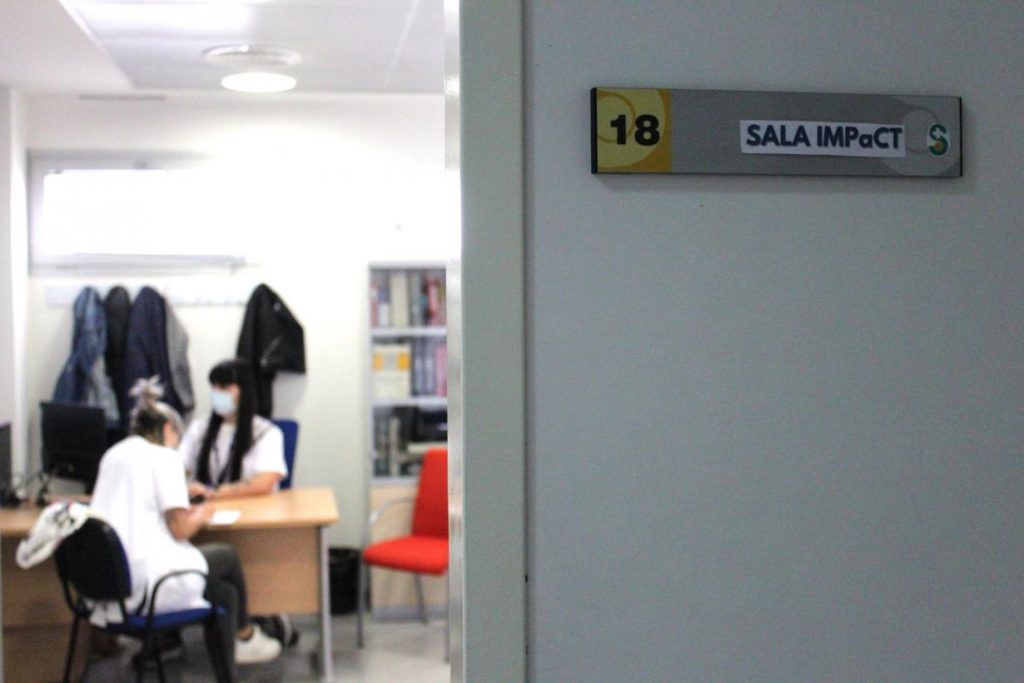
The pilot study of the IMPaCT Cohort, which is being carried out in four nodes in the Autonomous Communities of Aragon, the Balearic Islands, Castilla-La Mancha and Madrid, has already begun with the collection of information from the first participants contacted to take part, who have gone to the health centres authorised as IMPaCT centres.
This is the beginning of the citizen participation phase in this large cohort, whose ultimate objective is to carry out an exhaustive health study of 200,000 people representative of the Spanish population over the next 20 years to better understand the origin of the main diseases and thus help prevent them.
Aragon participates in the IMPaCT Cohort through the Health Research Institute of Aragon (IIS Aragón), the Department of Health and the Aragonese Health Service. The pilot study in this Autonomous Community, coordinated by Luis Hijós from the IIS Aragón, begins in the rural node of Monzón, which is made up of the aggregation of the Basic Health Zones of Barbastro, Binéfar, Monzón Urbano and Monzón Rural.
In the Balearic Islands, it is coordinated by Joan Llobera, director of the Primary Care Research Unit of Mallorca, through the Health Research Institute of the Balearic Islands (IdISBa) and is carried out in the Health Centers of Santa Ponça (Calvià) and Sa Pobla.
For its part, in Castilla-La Mancha the study is led by Ignacio Párraga from the Health Service of Castilla-La Mancha, through the Foundation of the National Hospital for Paraplegics for Research and Integration (FUHNPAIIN), and begins in the node created in the Integrated Care Management of Albacete and of which the Health centers 8 and 4 of the city are part.
Finally, in the Community of Madrid, the pilot study is coordinated by Isabel del Cura, head of the Research Unit of the Primary Care Care Management, and Teresa Sanz, also a researcher at the Unit, through the Foundation for Primary Care Biomedical Research and Innovation (FIIBAP) and has begun at the General Ricardo Health Center. in the Carabanchel neighbourhood.
The importance of citizen collaboration
The IMPaCT Cohort project will collect information from participants through questionnaires, physical examinations, physiological tests and biomarker analysis in biological samples, which will be carried out in each health centre. “The collaboration of citizens is essential. We trust that the population understands the potential of the project, which will have an impact on improving the health of the entire population, and participates if they are called from their health center,” says Marina Pollán, principal investigator of the IMPaCT Cohort and scientific director of CIBERESP.
A project of everyone and for everyone
To prevent the onset of a disease, it is necessary to know well what causes that disease. Thus, having information on a large number of people and following them over time will make it possible to predict the risks of getting sick at an individual level in the future, thanks also to advances in genomics, the digital field and ICTs, which facilitate this personalized approach.
Cohort projects are studies in which a large group of people representative of the population are selected and collect exhaustive data on each of the participants over the years.
The IMPaCT Cohort, promoted and funded by the Carlos III Health Institute (ISCIII), involves 21 Spanish institutions, including primary care centres, hospitals and research centres, and the National Institute of Statistics (INE). This important project, whose scientific coordination is carried out by the Center for Biomedical Research in Network (CIBER), has the advice and participation of a large number of researchers and professionals from our country.
The study plans to be implemented in 50 health centers (IMPaCT centers) throughout Spain, from which randomly selected participants will be contacted and monitored. In line with the distribution of the Spanish population, 30% of these centres will be in rural areas and another 70% in urban areas.
“If they call you, come!”
Citizen participation in the project is launched over the next few weeks with this pilot study, which is being developed in the first IMPaCT centres in Madrid, the Balearic Islands, Aragon and Castilla-La Mancha.
People whose health center is part of any of the four nodes of the pilot study may be contacted to participate in the study. From the coordination of the project they make a call for the participation of citizens: “if you receive a call from your Center, do not hesitate, come”.
Central role of Regional Health Services
There are successful examples of cohorts in other countries such as the United Kingdom, France, Germany or the USA. These cohorts have biological samples, with very extensive epidemiological information – including social and economic factors – and constitute the basic tool for advancing personalized prevention. Thus, the IMPaCT Cohort will allow a qualitative leap in research on precision preventive medicine in Spain, placing our country at the same level.
The creation of this cohort is a shared effort with all the Regional Health Services of the Autonomous Communities and INGESA (the two autonomous cities), together with the INE.
Data of great value for the scientific community
The data of the participants collected will be available for the development of other scientific projects of interest to society. “The IMPaCT cohort will allow the scientific community to better understand how to prevent the main diseases and age-related deterioration, injuries and disability,” says Marina Pollán.
The possibility of having a dynamic record of individual and population, clinical, genetic, epidemiological and lifestyle data will make it possible to build predictive models of disease, identify health inequalities, monitor key indicators and evaluate the impact of health policies.
This Cohort is part of the Predictive Medicine axis of the IMPaCT infrastructure, which promotes the ISCIII, which is the basis for the implementation of Precision Medicine in the National Health System through a strategy based on science and innovation. The IMPaCT infrastructure consists of three programs: Genomic Medicine, Data Science and the aforementioned Predictive Medicine.