




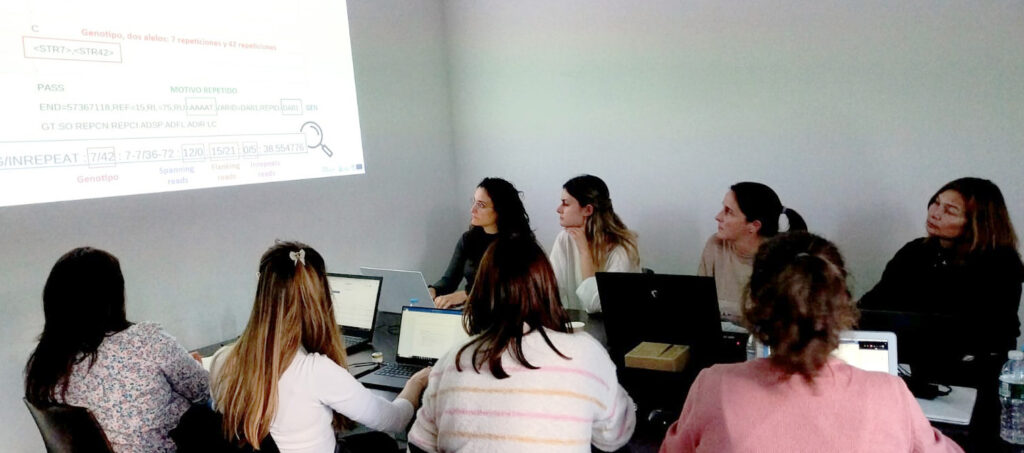
The Hospital 12 de Octubre in Madrid hosted the WGS Practical Course on Analysis for Rare Diseases organized by IMPaCT-GENóMICA, which was an intensive training day for case managers on the resolution of complex diagnostic cases received in the program.
The organisers of the course celebrate the success of the conference, held on 6 November, for its contribution to the “advance in the interpretation of genomic data in the field of rare diseases, which promises to have a significant impact on the resolution of complex cases received in the programme”.
The conference focused on the main possible advances with the study of genomes, still in the field of research, with respect to the sequencing of exomes thanks to the information that genomes report in a distinctive way and that will undoubtedly mean an increase in the diagnostic rate.
The practical training began with the explanation, by the manager of the program Yolanda Benítez, of the work carried out by the IMPaCT transversal working group in which the analysis pipelines have been established.
The day continued with a session on interpretation of variant analysis in mitochondrial DNA given by Alberto Blázquez and Pablo Serrano, experts in mitochondrial pathologies of the CIBERER group at the Hospital 12 de Octubre.
Rosario Carmona and Virginia Aquino, researchers at the Progress and Health Foundation of Andalusia and members of the CIBERER bioinformatics group from which they collaborate with the ENoD (Undiagnosed Diseases) program, carried out a theoretical-practical session on STR analysis (short tandem repeats) and interpretation of SVs (structural variants) in the IGV (Integrative Genomics Viewer) tool). The adequate analysis of these variants constitutes an added value in genome studies and it is estimated that it can respond to a significant percentage of unsolved cases.
Finally, from the functional validations working group of IMPaCT-GENóMICA, CIBERER researchers Karen Heath (IdiPAZ) and Obdulia Sánchez (CBMSO-UAM) addressed the practical resolution of variants of uncertain significance (VUSes), emphasizing splicing variants and how to approach the study of variants in non-coding regions.
The session ended with a summary sharing and practical discussion of the analysis strategies to be followed in genome studies.
“This educational effort represents a valuable investment for the advancement in the interpretation of genome sequencing data and, consequently, for the improvement in the diagnosis of rare diseases,” they highlight from the organization of the conference.
“By equipping case managers with specialized skills and knowledge ,” they continue, “the IMPaCT-GENóMICA project begins its commitment to training, which will be extended to other professionals and thus ensures its contribution to the implementation of precision medicine.”